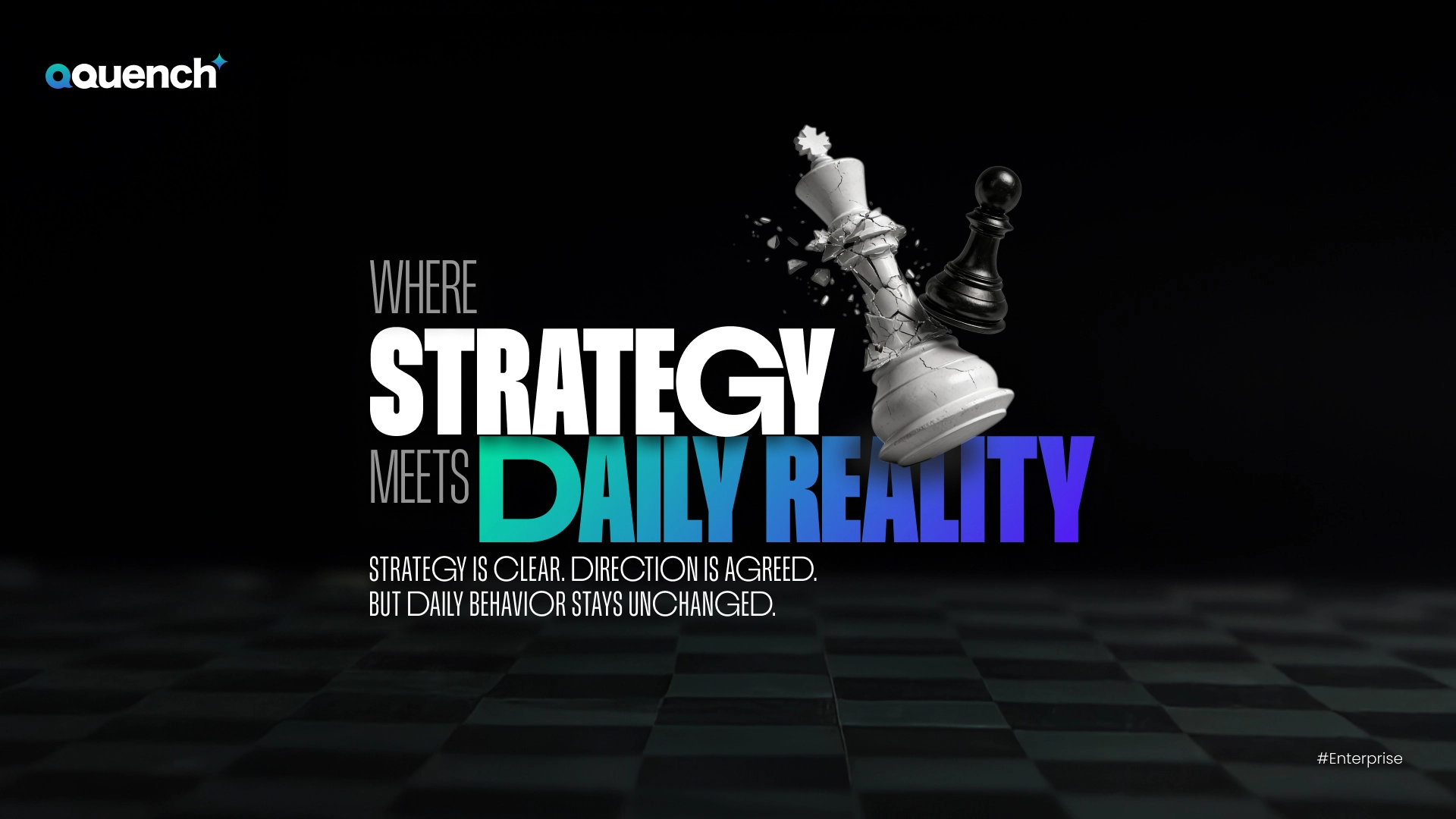
Strategy Alignment Is Not Execution
Organizations spend months shaping strategy.
Vision statements.
Roadmaps.
Town halls.
Alignment is achieved.
Execution is not.
This disconnect is not cultural.
It is systemic.
As established in Why Adoption Drops After Enterprise Rollouts, success signals often mask behavioral stagnation.
Strategic intent can be widely understood while operational behavior remains unchanged.
Communicated, Not Operationalized
Most strategies are:
- Explained
- Broadcast
- Repeated
Few are embedded.
Daily work continues to be shaped by:
- Existing incentive
- Legacy tools
- Old approval paths
Without operational changes, it remains an informational signal rather than a behavioral one.
Gartner research confirms that strategy fails when execution systems remain unchanged:
Behavior Follows Systems, Not Intent

People do not resist it.
They follow what the system rewards.
If:
- Metrics stay the same
- Tools stay the same
- Decision paths stay the same
Behavior stays the same.
Operational structures shape behavior far more strongly than strategic messaging.
This mirrors the pattern explored in Design Shapes Decisions.
Harvard Business Review reinforces that execution depends on decision architecture, not messaging:
Strategy Collides With Operational Reality
It assumes:
- Capacity
- Clarity
- Alignment
Operations experience:
- Overload
- Fragmentation
- Trade-offs
This tension explains why strategy stalls in the middle layers.
Operational complexity often dilutes strategic intent before it reaches frontline execution.
As discussed in The Hidden Cost of Too Many Internal Systems, operational complexity silently defeats strategic intent.
Leaders Underestimate the Translation Layer
Between strategy and execution sits an invisible layer:
- Decision rules
- Default behaviors
- Workflow constraints
This layer determines whether strategy survives.
This translation layer quietly governs how work actually happens across teams.
As shown in When Platform Modernization Does Not Change Behavior, intent without system redesign produces cosmetic change.
This Becomes Practice When Systems Change
It succeed when they:
- Redesign decision flow
- Change defaults
- Remove old incentives
- Reinforce new behavior
Conceptual reference:
Strategic Intent vs Behavioral Infrastructure
It moves minds. Systems move behavior.
When systems change, strategic direction becomes operational reality.
This is where execution is won or lost.
Strategy Is a Design Problem
This does not fail because people forget it.
It fails because systems ignore it.
Until daily work is redesigned to reflect strategic intent, strategy remains aspirational.
Execution is not about belief.
It is about structure.
Explore more:
- Why Adoption Drops After Enterprise Rollouts
- Why Knowing More Does Not Lead to Doing Better
- Why Knowing More Does Not Lead to Doing Better
- The Hidden Cost of Too Many Internal Systems
- Why Digital Transformation Stalls After Implementation
- Automation Readiness vs Automation Ambition
- Enterprise Experience Design
- AI & Automation Strategy
Turn Strategy Into Daily Practice
Talk to Qquench about redesigning systems, workflows, and decision paths so strategy shows up in daily work.
FAQ: Knowing vs Doing
1. Why does strategy fail to translate into execution?
Because systems, incentives, and workflows remain unchanged.
2. Is this a leadership communication problem?
No. It is a system design problem.
3. What makes strategy stick?
When daily decisions, tools, and metrics reinforce strategic intent.
4. Who owns strategy execution?
Leadership owns intent. Systems own behavior.