Transformation Failures Are Often Invisible
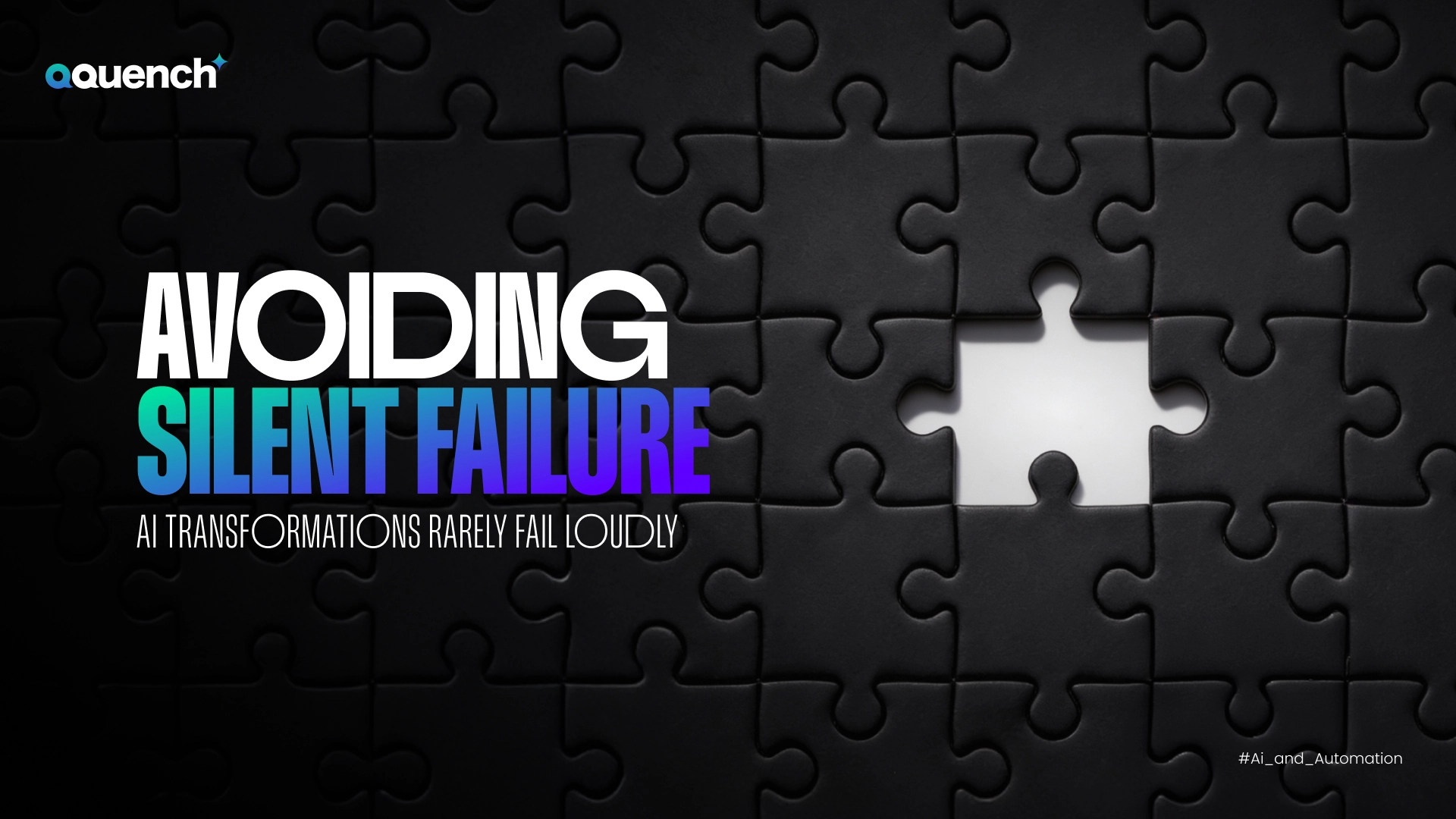
AI failures rarely announce themselves.
There is no dramatic moment of collapse.
Instead:
- Models are bypassed
- Recommendations ignored
- Automation quietly overridden
By the time leaders notice, value has already evaporated.
As established in When AI Undermines Accountability, erosion happens gradually, not suddenly.
Silent degradation often begins at the behavioral level long before it appears in system metrics.
AI Transformation Failure Looks Like Stability
Silent failure is characterized by:
- Flat usage metrics
- No obvious incidents
- Steady operational output
This masks disengagement.
Operational teams may already be bypassing AI systems while dashboards continue to signal stability.
Gartner research confirms that AI initiatives often underperform without triggering formal failure signals:
Overrides Are an Early Warning Signal

When AI transformation begins to fail:
- Humans override decisions
- Manual checks reappear
- Parallel workflows emerge
These signals rarely reach dashboards.
Override behavior is often the earliest indicator of declining trust in AI systems.
As discussed in Efficiency Creates Friction, hidden work absorbs system failure.
Harvard Business Review notes that silent disengagement precedes visible transformation failure:
Leadership Distance Delays Detection
CXOs experience AI through:
- Reports
- KPIs
- Summaries
Teams experience AI transformation through friction.
This distance delays awareness.
Operational signals of failure often remain localized long before they escalate to executive visibility.
As shown in Why AI Pilots Succeed but Fail to Scale, leadership often sees success while operations absorb failure.
Accountability Gaps Enable Quiet Decay
When accountability is unclear:
- No one flags decline
- No one owns correction
- Drift becomes normal
Without clear ownership, small adoption failures accumulate into systemic decline.
This reflects the erosion described in AI Needs Governance.
Nielsen Norman Group research shows that automation bias and disengagement increase when feedback loops are weak:
Leaders Must Design for Failure Detection
Preventing silent failure requires:
- Monitoring override rates
- Tracking trust signals
- Surfacing workarounds
- Reviewing decision outcomes
Conceptual reference:
Model Accuracy vs Decision Adoption
Accuracy without adoption is silent failure.
Leaders who track behavioral adoption signals detect failure much earlier than those relying only on model performance metrics.
This is how leaders regain visibility.
Silence Is a Signal
AI failure does not always look like chaos.
It looks like:
- Indifference
- Workarounds
- Quiet disengagement
Leaders who listen for silence intervene early.
Those who do not discover failure after value is gone.
Explore Further:
- AI Undermines Accountability
- Role Ambiguity
- Pilots Fail to Scale
- Readiness vs Ambition
- Transformation Stalls After Implementation
- Knowing ≠ Doing
- AI Governance & Guardrails
- AI Readiness Assessment
Detect AI Failure Before It Goes Silent
Talk to Qquench about designing AI systems with visibility, accountability, and early-warning signals.
FAQ
- Why does AI fail quietly?
Because disengagement, overrides, and workarounds are not tracked as failures.
2. What are early signs of AI failure?
Rising overrides, declining trust, and parallel manual processes.
3. Why do leaders miss AI failure?
Because dashboards show performance, not adoption or trust.
4. How can organizations prevent silent AI failure?
By monitoring behavior, accountability, and decision adoption.