Automation Changes Authority Structures
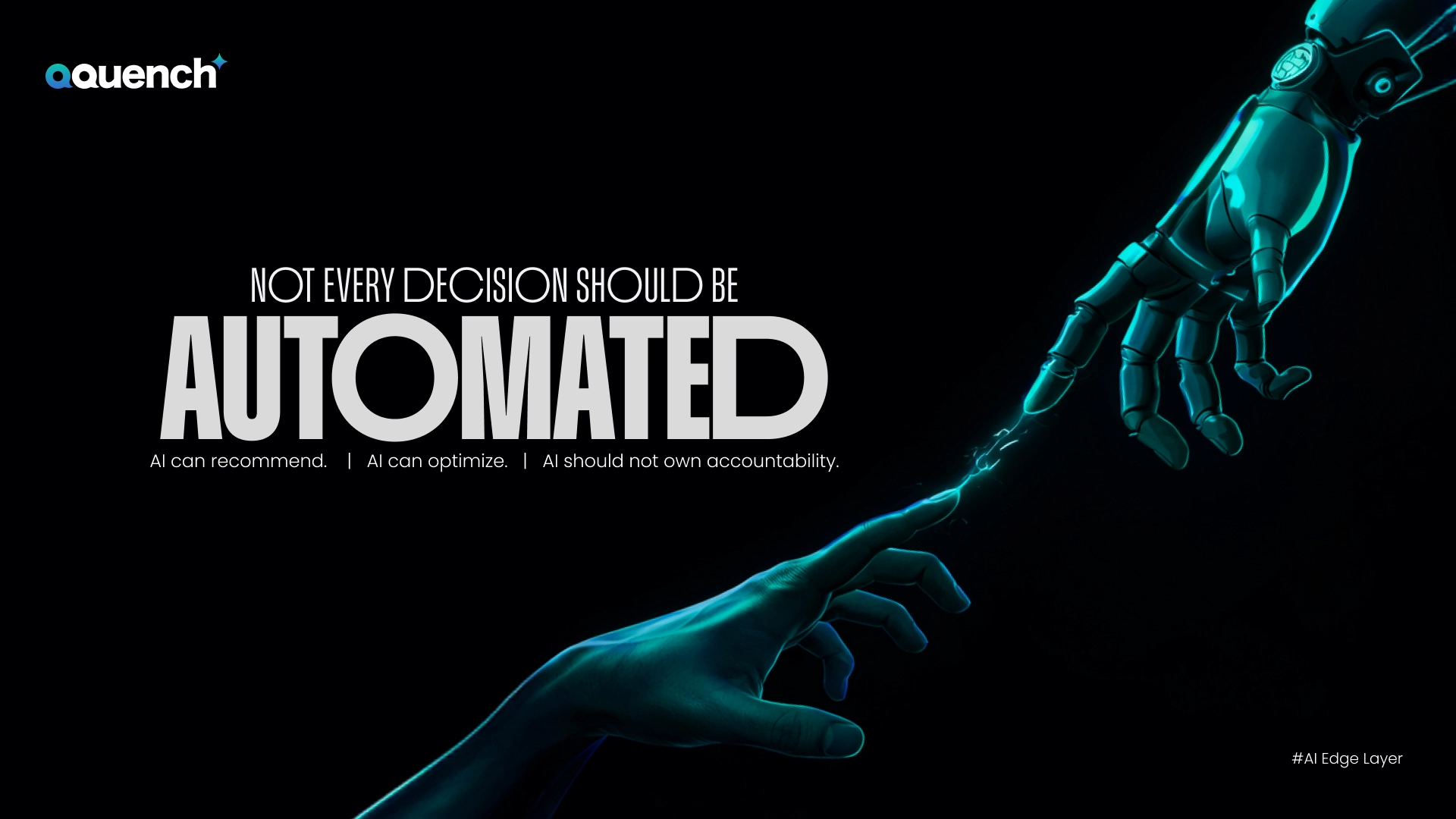
AI does not only automate tasks.
It reshapes authority.
When AI systems:
- Recommend credit approvals
- Flag compliance risks
- Prioritize customer leads
- Suggest hiring candidates
They influence decisions.
Influence without defined accountability creates structural risk.
The OECD AI Principles emphasize human oversight and accountability as foundational requirements for trustworthy AI systems.
AI maturity requires boundary clarity.
As AI adoption expands across enterprise workflows, organizations must redesign decision authority structures.
Recommendation vs Decision Authority
There are three levels of AI involvement:
- Assistive AI – provides suggestions
- Augmented AI – shapes prioritization
- Autonomous AI – executes decisions
Confusion often arises between levels two and three.
As discussed in Agentic AI Without Governance Is Risk
Autonomous systems require explicit guardrails.
Without boundaries, recommendation quietly becomes decision.
Enterprises often underestimate how quickly advisory systems begin influencing operational outcomes.
Accountability Dilution Is a Real Risk

When AI outputs are wrong, enterprises often struggle to answer:
Who approved the decision?
Who validated the input data?
Who monitored model drift?
Harvard Business Review highlights that unclear accountability structures undermine digital transformation success.
AI magnifies this risk.
If roles are undefined, accountability becomes collective — which often means absent.
This connects directly to:
When AI Undermines Accountability
Without explicit decision ownership, responsibility becomes ambiguous when AI systems influence outcomes.
Human Override Mechanisms Are Not Optional
Enterprises must design:
- Escalation pathways
- Manual review triggers
- Risk thresholds
- Audit logging systems
NIST’s AI Risk Management Framework explicitly includes human oversight as a core component of responsible AI deployment.
Override systems are not a sign of mistrust in AI.
They are a sign of governance maturity.
Human intervention mechanisms ensure that AI systems remain accountable within enterprise control frameworks.
Decision Boundaries Vary by Risk Level
Not every workflow requires equal human involvement.
Low-risk examples:
- Content drafting
- Internal summarization
- Scheduling assistance
High-risk examples:
- Financial approvals
- Regulatory reporting
- Legal decisions
- Healthcare or safety actions
Gartner’s AI maturity models emphasize risk-tiered governance structures for scalable AI deployment.
AI boundary design should reflect risk classification.
Cultural Impact: Trust and Responsibility
If employees feel AI:
- Makes decisions without transparency
- Overrides expertise
- Cannot be questioned
Trust erodes.
MIT Sloan research notes that successful AI adoption depends heavily on transparent human–machine collaboration models.
This aligns with themes explored in:
Data Readiness Determines AI Success
Trust rests on transparency.
Transparency rests on boundary clarity.
Organizations that clearly define AI decision roles build stronger adoption and trust.
Designing Human–AI Decision Architecture
A mature enterprise AI decision model defines:
- What AI can recommend
- What AI can auto-execute
- When human approval is mandatory
- When escalation is required
- How decisions are logged and reviewed
This is not technical design alone.
It is organizational design.
It defines power structures.
Human–AI collaboration models reshape governance and authority within modern enterprises.
Why This Impacts ROI
AI ROI depends on:
- Adoption
- Trust
- Consistency
- Reduced rework
If decision boundaries are unclear:
- Employees bypass AI
- Leaders distrust output
- Compliance risk rises
- Adoption declines
This connects directly to:
ROI improves when governance is embedded.
Clear accountability frameworks increase both AI adoption and measurable value.
Intelligence Requires Accountability
AI enhances enterprise capability.
But capability without accountability is unstable.
Human–AI collaboration must be designed explicitly.
Enterprises that define clear boundaries:
- Preserve accountability
- Build trust
- Scale responsibly
- Reduce risk
AI should extend human judgment.
It should never obscure it.
Explore Further:
- Agentic AI Without Governance Is Risk
- AI Undermines Accountability
- Data Readiness Determines AI Success
- AI ROI Is Misunderstood
- AI & Automation Services
Design AI With Clear Decision Architecture
Talk to Qquench about defining human–AI boundaries that preserve accountability while enabling scale.
FAQ
- What are human–AI decision boundaries?
They define which decisions AI can recommend, execute, or escalate to human authority.
2. Why are decision boundaries important?
They preserve accountability, reduce risk, and build trust in AI systems.
3. Should AI fully automate high-risk decisions?
No. High-risk decisions require structured human oversight and escalation pathways.
4. Who defines AI decision authority?
CXO leadership, CIO, risk, compliance, and operational heads collaboratively.