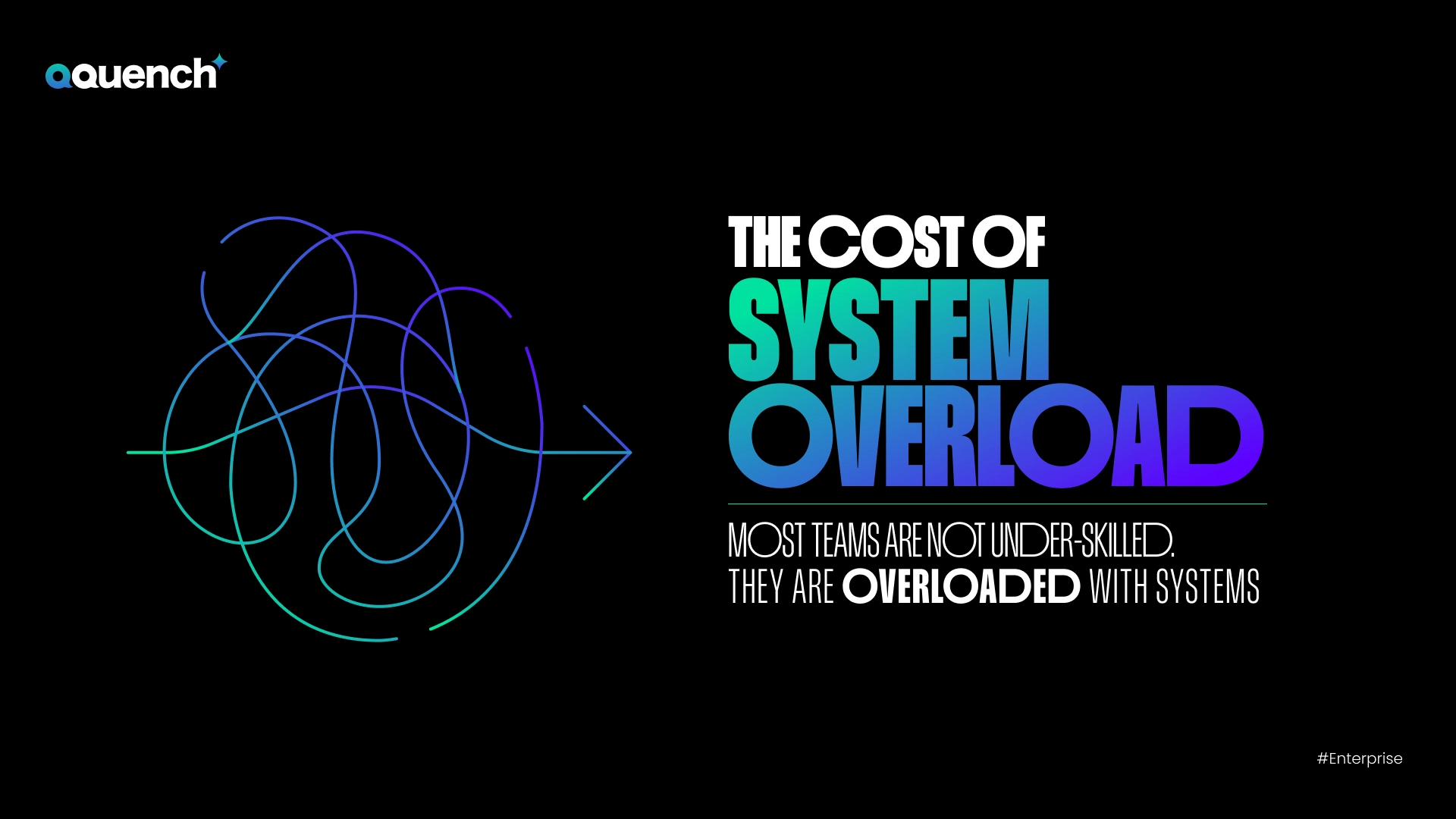
The cost of overload masquerades as underperformance
When results decline, capability is questioned.
But most employees know what to do.
They just cannot do it efficiently. This is the operational cost of overload.
Because work is spread across:
- Multiple platforms
- Overlapping tools
- Competing workflows
As shown in Why Resistance to Change Is Often Misdiagnosed, overload looks like resistance from the outside.
Operational complexity often hides behind the appearance of individual underperformance.
Every System Adds Cognitive Load at a Cost
Each new system requires:
- Context switching
- New rules
- Separate attention
Even when systems are good individually, their combined effect is destructive.
Human attention becomes fragmented as users navigate multiple digital environments.
Nielsen Norman Group confirms that context switching dramatically reduces task performance:
Tool Proliferation Is a Leadership Decision

Most system overload is not accidental.
It results from:
- Local optimizations
- Department-level buying
- Short-term fixes
Over time, complexity compounds.
Organizations often add systems faster than they retire them.
As discussed in Why Platform Modernization Does Not Change Behavior, new systems layered onto old ones rarely improve outcomes.
Training Is Used to Compensate for Bad System Design at a Cost
When systems multiply:
- Training increases
- Documentation expands
- Support tickets rise
Training becomes a coping mechanism.
Learning efforts frequently expand to compensate for structural system complexity.
This mirrors the failure pattern described in Training Does Not Change Behavior.
Harvard Business Review highlights that complex systems create execution drag even among skilled teams:
Overload Silently Kills Adoption
People respond to overload by:
- Avoiding systems
- Creating workarounds
- Sticking to familiar tools
Adoption metrics fall quietly.
Users naturally migrate toward the simplest available workflow, even if it bypasses official systems.
As shown in Why Adoption Drops After Enterprise Rollouts, overload accelerates disengagement after launch.
Reducing Systems Restores Performance
High-performing organizations:
- Retire systems aggressively
- Simplify decision paths
- Design for flow, not features
Conceptual reference:
System Count vs Cognitive Capacity
More systems reduce effective capability.
Simplification often produces larger productivity gains than adding new tools.
This is where productivity is regained.
Fewer Systems Create Better Work
The problem is not skill. It is the cost of overload.
It is overload.
Until organizations design for simplicity, performance will continue to erode quietly.
Productivity does not come from more tools.
It comes from fewer, better ones.
Explore more:
- Why Resistance to Change Is Often Misdiagnosed
- Why Strategy Rarely Becomes Daily Practice
- The Hidden Cost of Fragmented Digital Experiences
- Why Adding More Tools Rarely Improves Productivity
- Training Does Not Change Behavior. Design Does.
- Digital Experience Design
- AI & Automation Services
Reduce Systems Before Adding More
Talk to Qquench about simplifying platforms, workflows, and decision paths before complexity kills adoption.
FAQ: Knowing vs Doing
1. Why do too many systems reduce productivity?
Because cognitive load and context switching increase.
2. Is this a training problem?
No. Training often masks system design failures.
3. How can organizations reduce system overload?
By retiring redundant tools and designing unified workflows.
4. Who owns system complexity?
Leadership decisions create or prevent it.