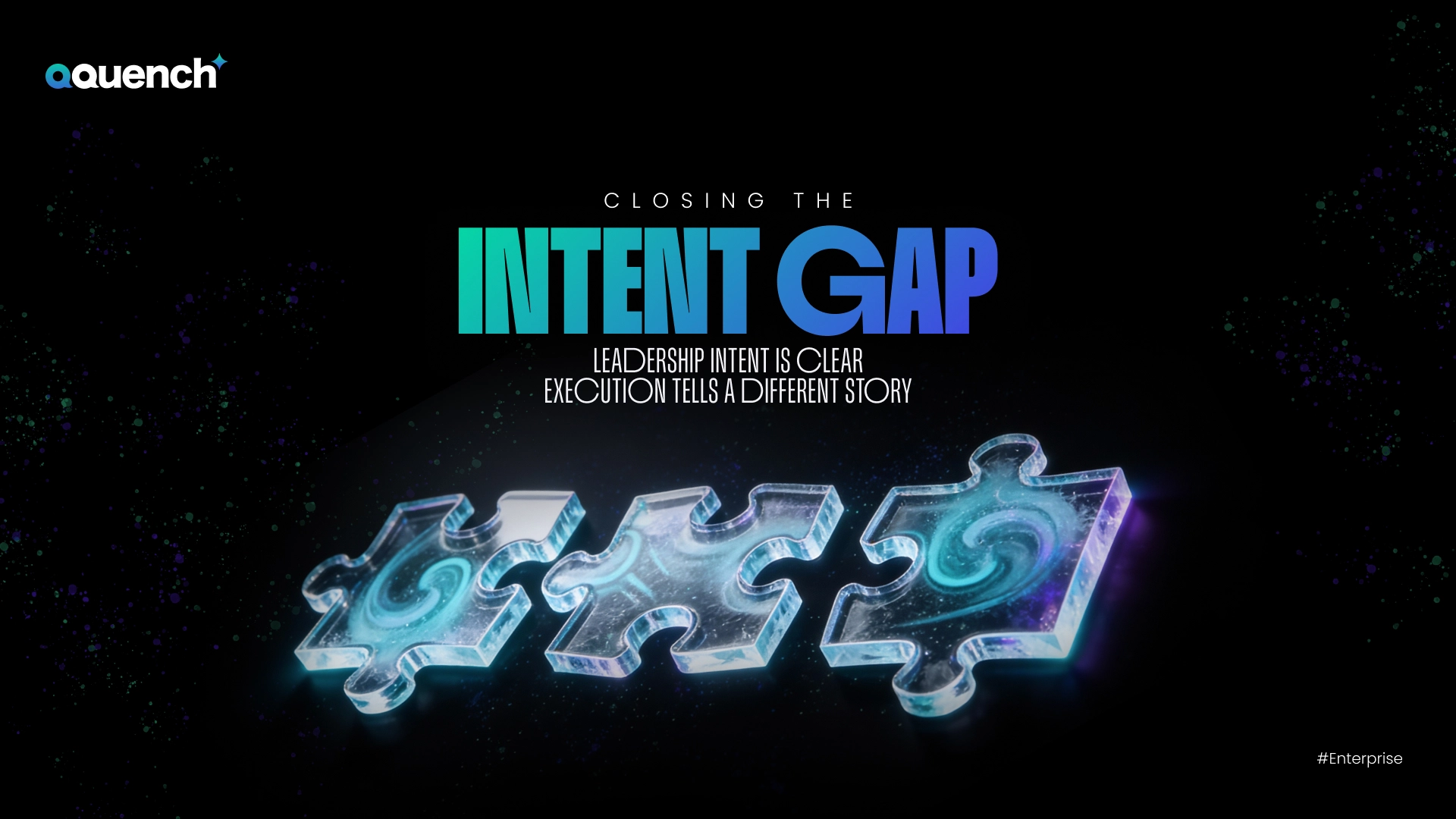
Intent Gap Does Not Execute Itself
Leadership intent is necessary.
It is not sufficient.
Organizations fail not because leaders lack clarity, but because systems do not enforce intent.
Intent defines direction, but daily systems determine behavior.
As established in Why Strategy Rarely Becomes Daily Practice, execution lives in systems, not statements.
Intent Lives in Documents, Practice Lives in Systems

Intent is communicated through:
- Strategy decks
- Town halls
- Values statements
Practice is shaped by:
- Metrics
- Incentives
- Tools
- Approval paths
If these do not align, intent dissolves.
Operational systems quietly override leadership messaging when incentives conflict.
Harvard Business Review confirms that misaligned incentives undermine leadership intent:
Middle Layers Absorb the Gap
The intent gap widens in:
- Middle management
- Cross-functional handoffs
- Operational trade-offs
People choose what keeps work moving.
Operational pressure forces teams to prioritize execution speed over strategic alignment.
As discussed in Transformation Feels Heavy, overload forces pragmatic shortcuts.
Gartner research shows that execution failure often originates in unmanaged middle layers:
Behavior Reverts Under Pressure
When pressure increases:
- Defaults resurface
- Old tools dominate
- Speed trumps intent
This explains why intent erodes during crises.
Under pressure, organizations rely on the easiest available workflow rather than the intended one.
As shown in Knowing ≠ Doing, knowledge without reinforcement does not hold.
Intent Gaps Are Design Gaps
The gap exists because:
- Decision rules are unclear
- Trade-offs are unresolved
- Consequences are misaligned
Design determines which behaviors survive operational pressure.
As explored in Design Shapes Decisions, design determines outcomes.
Nielsen Norman Group highlights that default behaviors dominate under cognitive load:
Closing the Intent–Practice Gap
Organizations close the gap by:
- Redesigning decision paths
- Aligning incentives
- Making the right action easier
Conceptual reference:
Intent Declaration vs Behavioral Infrastructure
What is easiest becomes standard practice.
Strategic intent becomes durable only when embedded into operational defaults.
Intent Must Be Engineered
Intent does not drift because people forget.
It drifts because systems allow it.
Execution improves when intent is built into daily work, not repeated in speeches.
Explore Further:
- Strategy Does Not Become Practice
- Transformation Feels Heavy
- Knowing ≠ Doing
- Design Shapes Decisions
- Design Affects Flow
- Enterprise Experience Design
- Leadership Enablement & Systems Design
Design Systems That Execute Intent
Talk to Qquench about embedding leadership intent into workflows, metrics, and decision paths.
FAQ: Intent vs Practice
Why does leadership intent fail to translate?
Because systems, incentives, and defaults remain unchanged.
Is this a communication problem?
No. It is a system and design problem.
Who owns the intent–practice gap?
Leadership owns intent. Systems determine practice.
How can organizations close the gap?
By redesigning daily decision environments.