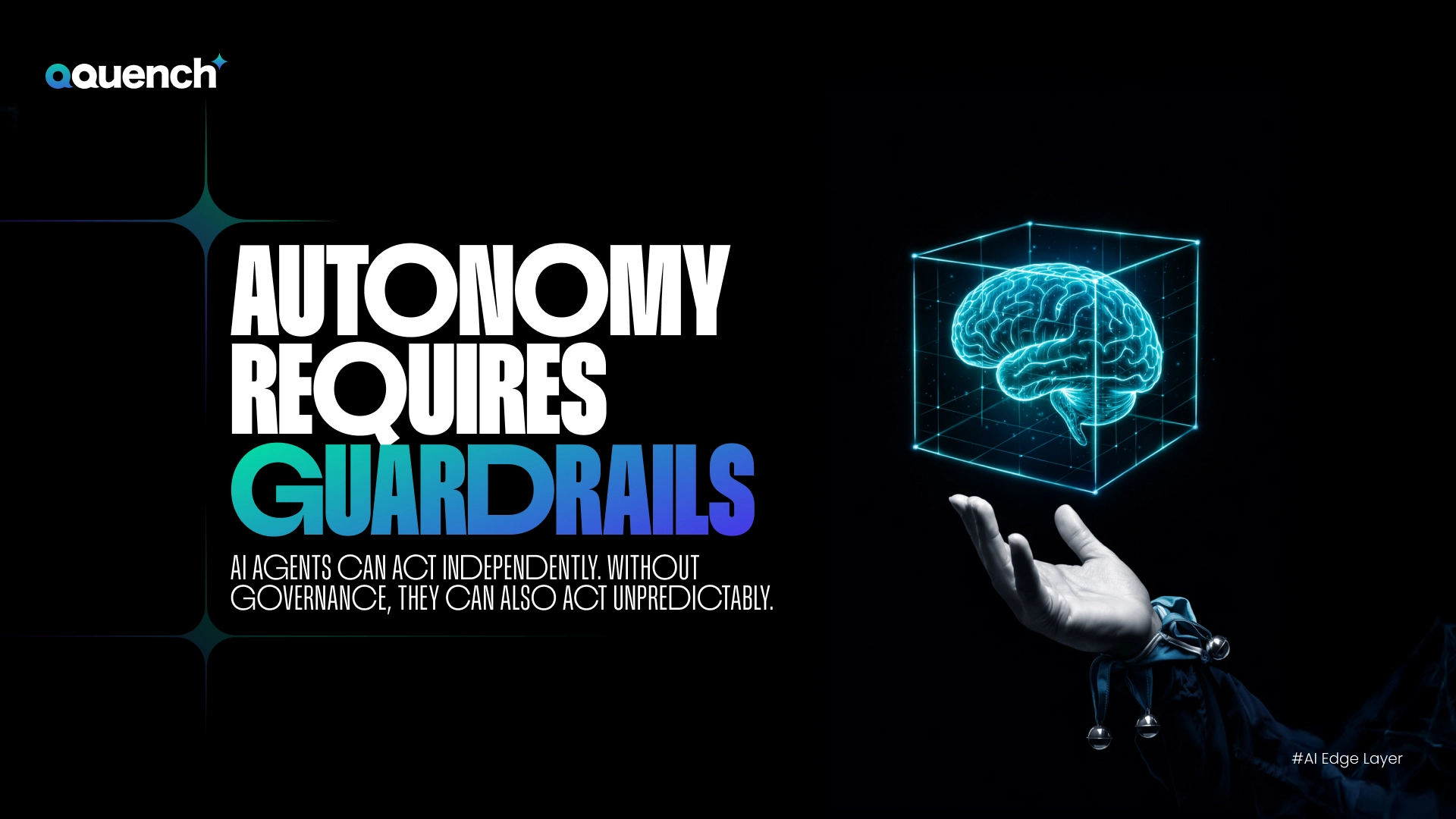
Autonomy Changes the Risk Equation
Traditional automation executes predefined instructions.
Agentic AI systems:
- Interpret goals
- Decide next actions
- Adapt in real time
This shift is architectural.
The Stanford AI Index 2024 highlights rapid growth in autonomous AI deployment across industries, particularly in workflow orchestration and decision support.
Autonomy increases speed.
It also increases exposure.
As AI agents gain decision authority, governance becomes a core architectural requirement rather than an optional control layer.
As explored earlier in AI Needs Governance
Intelligence without control does not scale safely.
Agents Do Not Just Execute. They Decide.
Agentic systems:
- Trigger workflows
- Retrieve data
- Generate outputs
- Escalate actions
When these actions influence customers, finance, or compliance, risk expands.
Autonomous decision-making introduces operational and regulatory exposure that traditional automation rarely created.
NIST’s AI Risk Management Framework explicitly warns that autonomous systems require continuous monitoring and human oversight.
Without structured control layers, enterprises lose visibility into:
- Decision pathways
- Data exposure
- Escalation logic
Governance Cannot Be an Afterthought

Most enterprises:
- Pilot AI quickly
- Add governance later
This mirrors the pattern discussed in:
Gartner reports that AI initiatives fail when governance maturity lags technology deployment.
AI governance must define:
- Decision boundaries
- Escalation rules
- Human override conditions
- Data permissions
Without predefined governance, autonomous systems introduce uncontrolled decision paths.
Agent Drift Is a Real Enterprise Concern
Autonomous systems adapt.
But adaptation without boundaries leads to drift.
Drift can:
- Change decision logic subtly
- Alter thresholds
- Optimize for unintended metrics
MIT Sloan research highlights that AI optimization can misalign with enterprise values when objective functions are poorly defined.
This is not a technical issue.
It is a systems design issue.
Unmonitored drift can gradually shift decision behavior away from intended policy or risk tolerance.
Guardrails Enable Scale
Governance is not restriction.
It is scalability infrastructure.
As established in When Governance Slows Progress Instead of Enabling It
Good governance:
- Defines non-negotiables
- Automates monitoring
- Logs decisions
- Preserves accountability
OECD AI Principles emphasize transparency, accountability, and human oversight in autonomous systems.
Guardrails allow enterprises to scale autonomous decision systems while maintaining visibility and accountability.
Human-AI Decision Boundaries Must Be Explicit
Not every decision should be autonomous.
Enterprises must define:
- What AI can decide
- What AI can recommend
- What requires human validation
This ties directly to:
Autonomy without role clarity creates blame ambiguity.
Clear decision ownership ensures that AI augments human judgment instead of replacing accountability.
Autonomy Demands Architecture
Agentic AI is powerful.
But autonomy without architecture introduces:
- Legal risk
- Reputational exposure
- Operational instability
AI success depends less on model intelligence and more on system governance.
Explore Further:
- AI Needs Governance
- Automation Readiness vs Automation Ambition
- AI Undermines Accountability
- AI & Automation Services
Design AI Systems With Guardrails, Not Guesswork
Talk to Qquench about building agentic AI frameworks with embedded governance and control architecture.
FAQ
- What is agentic AI governance?
Agentic AI governance defines decision boundaries, monitoring systems, and accountability frameworks for autonomous AI agents.
2. Why is agentic AI risky without oversight?
Because autonomous systems can adapt, drift, and make decisions beyond intended constraints.
3. How can enterprises reduce AI risk?
By embedding guardrails, human override mechanisms, and monitoring protocols.